
Discovering Europe 2026: A Maltese Food Journey

My 2025 was a bit of a shitshow, mainly full of concerns about money, stress around my career and imposter syndrome when seeing other, much bigger foodie influencers. It caused me to hold back from visiting restaurants and travelling, constantly worrying that I wasn't doing enough.
But throughout 2026 I have thought, fuck it, life is too short. This year, rather than worry, I have tried to enjoy life a lot more. I've done more travelling around Europe than ever before and eaten many a good meal along the way.

However, while all this was happening, Discovering Bites lay dormant. I still had huge imposter syndrome and was struggling to find time for it. But during the summer, I began to get the itch to post again and make some time for it. I also had several friends, colleagues and loved ones encouraging me to start it back up again.
So when I was faced with the renewal bill for the website, I was left with a decision: do I sack it all off or do I give it another go?
Well, as you can clearly see, I decided to give it another go.
So with my decision made to continue the blog, the next decision was what should my first piece be about. Should I use the old content stored up from last year? What about doing a deep dive into TikTok and Instagram to find the latest viral spot and jump on the hype train?
Nah.
Seeing as this has been the year where I have done more travelling, it makes total sense that I should write about these trips, discussing what I ate, what I saw and my recommendations for your own travels to these destinations.
So this is my Discovering Europe 2026 mini-series. A series of articles highlighting several European destinations, including Malta, the Netherlands, Brussels, Dublin, Valencia and Poland, starting with my trip to Malta and a Maltese Food Journey.
A Birthday Trip to Malta

Malta was a destination firmly on mine and Luna's cards after we started seeing countless videos of the island on social media. We couldn't quite believe how beautiful this tiny Mediterranean island looked, or how good so much of the food looked. We were particularly drawn to the Italian influence, with video after video showing plates of pasta, lasagne and other dishes that looked right up our street.
And it wasn't just us who seemed to have Malta on their minds. It felt like everyone we knew had visited this year, including plenty of my colleagues, which only made us more curious about the island. There was clearly something drawing people to Malta, and we wanted to see what all the fuss was about for ourselves.
In fact, Malta's huge presence on social media wasn't entirely by coincidence. In 2025, Visit Malta partnered with social-first agency Komodo on Meet Me in Malta: The Social Bucket List, a campaign using TikTok creators to showcase the island's hidden gems and encourage younger travellers to discover Malta for themselves. The campaign generated 21.5 million impressions.
So, Malta was firmly on our radar; we just needed the right opportunity to go. This July I turned 30, and with my birthday falling on a Thursday, I had the perfect excuse to turn it into a long weekend away. And, quite frankly, Malta sounded like a pretty good way to spend it.
Discovering Maltese Food

Malta's location in the middle of the Mediterranean, between Sicily and North Africa, combined with its long and complicated history of foreign rule, has resulted in a very unique fusion of influences in its daily cuisine. You'll find North African, Sicilian, Italian and British influences, with plenty of pasta, tomatoes, olive oil, spices, stews and slow-cooked dishes.
There are also some British influences that have found their way into Maltese food culture.
Of all the things you're probably going to find, there's a lot of pasta and pizza here. But don't take that to mean that the food is purely Italian. It's not. Maltese food is its own distinct cuisine, and while there are instances of pasta and pizza, they have their own Maltese versions.
Common local ingredients include rabbit, ġbejna (Maltese cheese), tomatoes, olives and capers, which we came across in many dishes during our trip.
Rabbit
Let's get the big one out the way, rabbit is everywhere in Malta. That's not because they hate Bugs Bunny, but Malta's limited land isn't particularly ideal for raising cattle, which has helped make these little fur balls an excellent food source for locals. For those that haven't tried rabbit before, it has a very similar taste and texture to chicken, although it can be a bit drier. Typically, you'll find it served on the bone or in pasta dishes.
We opted for two rabbit dishes on our holiday. The first was a traditional garlic and rabbit stew cooked in red wine and served with roasted vegetables. The stew is served more like a rich, dark sauce, which was really needed. We got several rabbit legs, with the meat falling off the bone, but on this particular occasion we found the meat very dry, so each bite needed a good mop-up of sauce.

Our second rabbit dish was rabbit ravioli at Roza (IG: @Roza_Bistro) in Victoria on Gozo Island. Located just a five-minute walk from the Game of Thrones-style Cittadella, Roza is a gorgeous restaurant set in a 900-year-old building, with al fresco-style dining in the equally beautiful St George's Square.
If you're new to rabbit and quite nervous about trying it, I strongly recommend this as an entry dish. The meat and its juices are held in the safety of a ravioli parcel and served with a light broth that's almost like a light stew gravy.
This was absolutely delicious and the portion was plentiful, with the broth being the star of the dish. Whereas the traditional stew needed us to mop up every drop to get through the dryness of the leg meat, this light pasta broth was divine and would almost warrant licking the plate clean.
Rabbit ravioli can be found across the country and is a huge recommendation from me.
Seafood - lots of it
Malta has access to an abundance of fresh Mediterranean fish, shellfish and crustaceans, and it can be found in many restaurants at incredibly affordable prices, something I wish was the case in the UK instead of the same old dreary prawns, salmon and cod options.
It's almost impossible to start this section as we ate so much delicious seafood, including mussels cooked in a wonderful white wine and garlic sauce, local prawn risotto (both eaten at the aforementioned Roza), the best lobster pasta dish I have ever eaten, tender calamari (none of that frozen rubber band nonsense here) and light sea bass fillets. I won't go into detail on every dish, but you really need to take advantage of the selection here, particularly if there is an Italian or Sicilian-inspired dish to choose from.
Ideally, get your seafood in towns by the ocean such as Valletta, where there is a greater selection of restaurants. Or do what we did and travel to Marsaxlokk, where the weekly Sunday market is held and is very popular with both locals and tourists.

You won't find much ready-to-eat seafood at the market itself, but all around it are plenty of restaurants to choose from. We even asked the tourist information team for a recommendation, to which they excitedly replied, "Impossible, everywhere is good, you cannot find a bad place."
We eventually settled on AZURE Bistro, where we had the best lobster pasta ever. The restaurant feels classy but you are warmly welcomed in and treated like friends coming over for dinner. They have daily specials with around four or five options, which is where we found the lobster linguine, while the à la carte menu is also based around seafood.
Along with the lobster pasta, we ordered calamari for starters and were given complimentary local bread with dips. Our second main was the sea bass fillets from the main menu, served with roasted vegetables, pesto and aioli. To drink, we opted for the crisp local white wine.

To be honest, we very much overdid this meal. The two mains would have been plenty, especially with the complimentary bread. The total bill came to €83 (£72), which we felt was incredibly fair considering the three glasses of wine, the amount of seafood we ate, the location and the service. There is a balcony overlooking the market, and the owner was incredibly kind enough to let Luna onto the balcony to take some photos.
You can get to Marsaxlokk easily by bus from Valletta. The main routes on Google suggest a two-bus transfer, but you can actually get the 81 bus, which takes a bit longer but delivers you right outside the market.
Beer, Wine and Prickly Pear Liqueur
Cisk & Maltese Beer
The most famous beer in Malta is Cisk, which is brewed locally by Farsons Brewery and is readily available in most bars and restaurants. Cisk Lager has been brewed since 1929 and is now exported around the world. It's a light, golden lager with a rich hop aroma that remains really refreshing, never making you feel too full, which I particularly enjoyed in the blazing heat.
Something I found quite interesting is that the size and price can vary depending on where you go. In a British-style pub you'll generally get a British-style pint or half pint, while Mediterranean-style restaurants often serve a European measure. The British-style pubs weren't too far off British prices, perhaps a euro or so cheaper, but the Mediterranean-style restaurants could be a couple of euros cheaper, particularly for the smaller European measure.
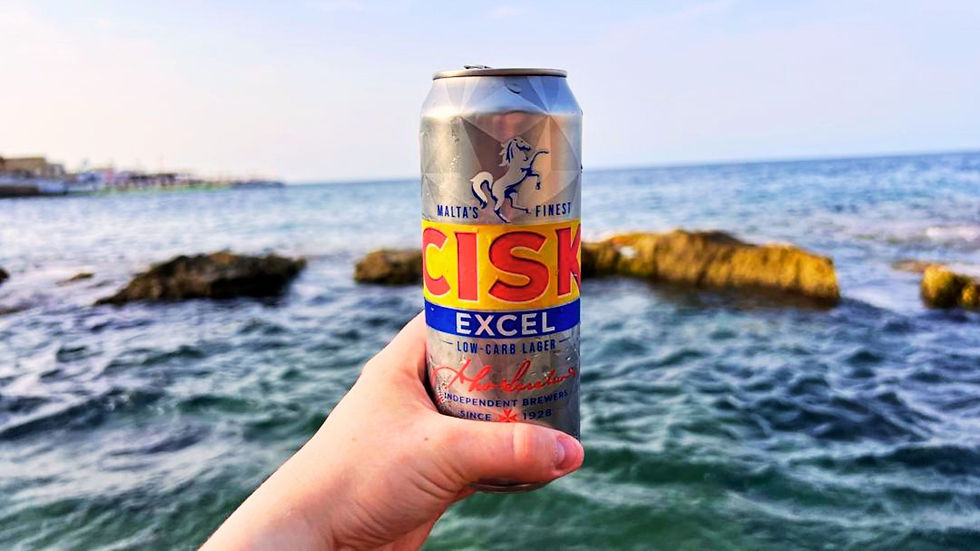
Alongside the original, you can also find Cisk Excel, a 4.2% low-carb lager with 50% fewer carbs than the original. I initially assumed this was designed for those wanting something lighter in the hot weather, but after speaking to a local, I was told it was popular with people who like going to the gym but still want to enjoy a beer. As a man that likes to go to the gym and also likes a beer, we're balancing that desire for a healthy body but also wanting to enjoy beer, so it makes sense in theory.
However, after drinking it, I found the flavour quite bland and it felt lighter despite having the same percentage as the original. If I was to have the two again, I'd definitely just go for the original.
There is also Cisk Session, a newer 3% lager designed for those looking to reduce their alcohol intake, although I didn't really see this one available during our trip.
Then there are the small cans of flavoured beer from the Cisk Chill range. We tried the lemon and melon, and of the two the lemon is significantly better. It's got a Radler-style flavour to it and was extremely refreshing and really tasty, making it perfect for the midday heat. The melon, however, felt very sickly. You get the sweetness of the melon at the beginning, followed by this weird bitterness from the beer at the end. Not really a fan.
So if you're going to pick one, go for the Cisk Chill Lemon.
Bajtra – Prickly Pear Liqueur
Of course, being just off the coast of Sicily, there is a strong Italian influence on Malta, which extends to aperitivos in the form of spritz cocktails. You can find your typical Aperol and Hugo spritz, but Malta has its own variant.

The people of Malta enjoy a liqueur called Bajtra, which I'd never heard of prior to visiting. Given Malta's hot, dry weather, prickly pear cacti have become widespread across the island, with many traditionally used as natural boundaries between properties. The spiky prickly pear fruit can be eaten raw or cooked, but in this case it's turned into a liqueur that is particularly sweet and comes out in a bright pink hue.
Of course, it can be drunk on its own, but typically you would have it as an aperitivo spritz. Unlike an Aperol Spritz, it's not sour, and unlike a Hugo Spritz, which can sometimes be a bit dry, this is a very sweet aperitivo, almost like a dessert in a glass.
You can get this aperitivo in many bars and restaurants, but if you just want to take one around Valletta, you can find a spritz stand just outside the Panini store on Triq San Gwann, giving you any spritz of your choice to take on your stroll around the city.
Maltese Wine
When we did have wine, we tried to always opt for something local. Seeing as it was the middle of summer, red wine wasn't really something we wanted, so we often picked white, which worked well considering we had lots of seafood.
I wouldn't say there was a particular variety of white wine that was better than another, but I found the Maltese whites to be very light, crisp and refreshing. In a couple of restaurants, we normally had around four local wines to choose from per colour, with two cheaper and two more expensive options. The price difference was usually only a couple of euros.
The prices aren't Central European cheap, but they're not as expensive as London either. Sometimes the premium options can reach London prices, but I'd say the huge difference is that unlike London, where you can pay premium prices and get a glass of vinegar, here the premium versions were exceptional wines.
If you're going for a nice sit-down meal, particularly seafood, I strongly recommend making the effort to try the local wine.
I also brought some Maltese red wine home with me from duty free and plan to try this soon, especially as the British weather has started to leave summertime behind and take a turn. So watch this space — I'll give you my review on that too.

Kinnie
Outside of alcoholic options, Malta has its own soft drink called Kinnie, brewed by Cisk. Made using a blend of oranges and aromatic herbs, it's almost a mixture of vermouth and Irn-Bru in flavour. At first glance, you'd think it was simply Malta's version of Irn-Bru, with the distinct orange flavour, but the herbs give it a more aromatic profile.
I'd actually say it's a little more pleasant than Irn-Bru, but I wouldn't typically pick this over a standard Coke or lemonade. It can also be used in cocktails, although I never got to try it that way.
Street Food & Snacks
There is also a small selection of street food you can find throughout Malta, the most famous being pastizzi, small, diamond-shaped flaky pastries normally filled with ricotta or peas, although you'll also find other fillings.
These little bundles of pastry are very messy, with flakes falling all over your clothes. We tried the ricotta and chicken versions, and of the two I actually thought the ricotta was much tastier, although it did become a little sickly after a while. At around €1 or sometimes even less, they're a great option if you're stopping for a quick coffee.

Sandwiches also seem to be quite popular here, with Italian-style fillings appearing in plenty of places. The most famous Maltese option is ħobż biż-żejt, made with traditional Maltese sourdough bread and typically filled with tomatoes, olive oil, capers, olives and tuna. It's a substantial sandwich, and you'll often see it paired with a bottle of Kinnie as an easy way to try two local favourites.
We didn't actually get the opportunity to try one during our trip, but we did visit Focacceria Dal Pani, a small sandwich shop in the middle of town, where we found some incredible focaccia sandwiches. If you're looking for a quick bite, it's definitely worth having on your radar.
My Favourite Moments of Malta

Boat Taxis
Beyond the food, there's a lot to love about Malta. One of the biggest things I really enjoyed was taking the taxi boats between Valletta and Sliema, and Valletta and the Three Cities. While it might seem mundane, these cute little boats aren't just used by tourists; they're a practical form of transport that locals use as well.
They're very small and once you're out on the ocean you feel like you're at its mercy, but in a wonderful way. It almost feels like you're in a James Bond or Indiana Jones film, where they've gone to some exotic location and are being escorted around.
The best journey is definitely between Sliema and Valletta. Sliema is the more modern part of the city, while the journey gives you fantastic views of Fort Manoel and, even better, the incredible Basilica of Our Lady of Mount Carmel and the Valletta cityscape. It looks breathtaking from the water, both during the day and at night.
These little taxi journeys cost €6 per person, one way. You typically have to pay by cash, but we used Revolut for every trip and the drivers were more than happy to accept payment this way.
Blue Lagoon
My other favourite moment of the holiday was visiting the Blue Lagoon. Malta has three main islands — Malta, Gozo and Comino — with Comino being the small island between Malta and Gozo. The best way to get there if you're staying in Valletta is to take the speedy ferry to Gozo, where you can find additional boat taxis that will take you to the Blue Lagoon.
Once you're there, it is incredibly busy, but the water is absolutely picturesque, some of the clearest blue I've ever seen in the ocean, and you just cannot wait to jump in.

The area is very busy and there are people selling sunbeds and umbrellas, which I strongly recommend using. There are lots of rocks around the water, and with only a couple of staircases down to the sea, it can get quite competitive. Having a sunbed means you can easily dip into the water and get back to your stuff without fighting your way through everyone else. The chairs are also particularly comfortable both Luna and I fell asleep at one point and had one of the nicest naps I've ever had.
Another aspect of the Blue Lagoon that was super fun was when the lifeguards blew their whistle and announced that we could swim across to the other side, where there's another rock formation and caves that you can walk into. This is Cominotto Beach. I consider myself a very strong swimmer, but it is a tiring swim between the two, and once you arrive, it's extremely rocky, so expect plenty of digs into your feet. Once you're there, though, it feels like you've achieved a really cool accomplishment.
There are also an abundance of food trucks in the area. The food isn't going to be the best you've ever tried, but I was surprised by how good it actually was. We ended up getting a pizza, a piña colada in a hollowed-out pineapple, fresh watermelon and a few beers, which came to about €50 in total.
The pizza was plentiful, again, not the best pizza, but there are a lot of Italians in the area and I saw plenty of them eating it, so if it's good enough for them, it's definitely good enough for me.
Horse Carriage Rides
Finally, one of the sweetest things we did on the trip was taking a horse-drawn carriage ride around Victoria in Gozo (You can also find these horse-drawn carts in Valletta). This was a particularly sweet moment with for me and Luna. The driver gave us a breakdown of the famous spots around the city and what they were currently used for, and even took a wonderful picture of us on the carriage.

The only thing we didn't like was what happened when we went to pay. We didn't have cash and the driver, who was a bit older, didn't have Revolut, so we had to go and get some money out. We came back with the money and, rather than let us give him a tip, he tried to keep the money for himself. To be honest, I would have given him a tip, but the way he behaved was horrible and was acting like we were trying to scam him. He then decided to speak badly about Luna as we walked away, which I thought was abhorrent.
This was the only real exception to the otherwise lovely behaviour we experienced in Malta. Every other Maltese person we met was absolutely golden, and I've since even considered possibly moving there in the future if I ever had the chance. purely because of the friendliness of the people and the climate.
Practical Advice
Malta is a former British colony, so English is widely spoken. The Maltese people were also some of the friendliest I've ever encountered. Usually when travelling around Europe as a Brit, you can expect the occasional snide comment about British food or Brexit, but in Malta we were met with genuine warmth. Everyone seemed to have a story about family living in the UK or being married to Brits, so don't be afraid to make conversation with strangers here.

We visited the day after my birthday in July, which was ideal in theory, but Malta is very hilly and you'll be doing a lot of walking. Combine that with the intense July heat and it became unbearable at times. We were constantly covered in sweat and having to stop for a drink or catch our breath.
Based on our experience and some research, July and August are the hottest months, while June and September should offer hot but more tolerable temperatures. Outside of these months, the weather is considerably cooler.
For payments, Revolut is widely accepted, so if you don't have cash on hand, make sure you have it ready to use. When you arrive at the airport, one of the first things I'd recommend doing is buying a bus pass. You probably won't need it if you're staying around Valletta, but if you want to explore more of the island, the bus network is a reliable and practical way to get around. We paid €... for four days and used it frequently.
Finally, wear comfortable trainers and pack light. Much of the island is hilly, and in the intense summer heat some of those inclines were occasionally torturous. A bottle of water, sunglasses and a hat will go a long way.
Final Thoughts — My Maltese Food Journey
For us, Malta was a really great trip. Neither Luna nor I have stopped thinking about it since, and we've even found ourselves saying to each other that we should live somewhere like Malta one day.

Our biggest takeaway wasn't necessarily the tourist destinations or even the food, but the genuine warmth and friendliness of the people. Apart from the horse and cart driver, almost everyone we met was absolutely lovely. Malta is genuinely one of the nicest places I've ever visited and, for me, comes close to China for the best hospitality I've experienced.
But the Maltese food is another reason I'd happily return. The culinary culture has the best of everything in my opinion: the freshness and variety you'd expect from a Spanish, Italian or French coastal destination, genuinely good British pubs when you're feeling homesick, and Cisk, which is addictively good. The local wine is also exceptional.
Prices sit somewhere in the middle. You're not getting Central European prices, but things are generally cheaper than London, which already feels like a huge win.
More importantly, this trip actually influenced my food journey after returning to England. I've started making an effort to visit a local fishmonger every week, try different types of fish and get more seafood into my diet rather than sticking to the same old options you find in British supermarkets. The trip was also a huge factor in giving me the itch to restart the blog, seeing and eating so many wonderful things.
And for that, I thank Malta.
Comments